
Updated: May 2024
Available languages: English (/en), Traditional Chinese (/tw), Simplified Chinese (/zh), Korean (/ko).
On this page
How Does Foreign Property Ownership Work in Vietnam?
Walk into a sales gallery along Mai Chi Tho in Thu Duc City on launch weekend. You see a split room. Domestic buyers take standard payment schedules across 24 to 36 months. Overseas buyers from Taipei, Hong Kong, and Seoul sit at desks marked for foreign inventory, reviewing the Sales and Purchase Agreement (SPA). That boundary sets the market rules. Non-resident buyers face strict 30% unit ceilings, State Bank of Vietnam currency controls, and a 50-year ownership title instead of freehold land ownership.
What Are the Foreign Ownership Limits Under Housing Law 2023?
Non-resident buyers operate under Housing Law 2023 (Law No. 27/2023/QH15) and Decree 95/2024/ND-CP. These statutes govern legal title from reservation to Pink Book issuance.
What Are the Foreign Quota and Ownership-Term Limits?
Article 19 of Housing Law 2023 caps foreign ownership at 30% of total residential units within a single condominium building (for example, 150 units in a 500-unit high-rise). For landed projects inside one ward-level administrative boundary, the cap sits at 250 landed homes or villas. Once a project hits this 30% threshold, non-residents cannot purchase units under an official developer SPA. Units sold past this statutory cap run on Long-Term Lease (LTL) contracts, which lack equivalent legal title.
Article 20 of Housing Law 2023 sets tenure. Non-resident individuals receive a 50-year ownership term starting from the issuance date of the Certificate of Land Use Rights and Ownership of House (Pink Book). Owners can apply for a one-time 50-year extension before expiration. Foreign owners retain statutory rights to lease, assign, inherit, and mortgage the property through credit institutions licensed in Vietnam.
How Does Resale Title Conversion Work for Foreign Owners?
Selling to a domestic citizen expands liquidity. When a foreign owner sells an official foreign-quota SPA unit to a Vietnamese national, legal tenure converts automatically. The domestic buyer receives permanent freehold status under Vietnamese law. The foreign seller enters on a 50-year ownership term and exits into the full domestic (Vietnamese) buyer pool.
How Do You Transfer Capital In and Out of Vietnam?
Cross-border funds move under State Bank of Vietnam anti-money laundering protocols and foreign exchange controls. Missing documents trap capital inside domestic accounts on exit.
- Direct Inward Remittance: Remit funds from an offshore bank account in the buyer's exact passport name directly to the developer's certified escrow account, or to a non-resident VND/USD capital account at a licensed domestic bank.
- Transaction Coding: Wire reference lines must state the investor name, project name, unit number, and reservation or SPA contract identifier.
- Customs Declarations: Never bring undocumented physical cash. Customs declarations stamped at Tan Son Nhat or Noi Bai airports are required for cash amounts exceeding 5,000 USD (or equivalent foreign currency) or 15,000,000 VND; commercial banks reject cash deposits lacking official airport stamps.
- Capital Repatriation: Outward remittance of sale proceeds and net rental gains requires proof of clean funds. Commercial banks demand the executed SPA, Pink Book or approved assignment contract, official tax clearance receipts, and original SWIFT MT103 proofs of inward remittance.
What Taxes Apply to Foreign Property Investors?
Vietnam assesses transaction and rental taxes on gross value rather than net capital gains.
What Is the Disposal Tax on Property Transfers?
Vietnam charges personal income tax (PIT) on gross transfer values. Non-resident sellers pay a flat 2% PIT on the gross contract price authenticated at the notary office, even if the unit sells at a loss. Factor this 2% transfer tax alongside notary fees of roughly 0.1% (capped at statutory maximums) and brokerage commissions of 1.5% to 2%.
How Is Non-Resident Rental Income Taxed?
Gross annual rental revenues above 100,000,000 VND (~4,000 USD) incur local revenue taxes. Non-resident landlords pay a combined 10% tax on gross rental turnover: 5% Value Added Tax (VAT) and 5% Personal Income Tax. Property managers in Ho Chi Minh City and Ha Noi withhold and remit these amounts directly to district tax departments.
Which Vietnamese Property Markets Attract Foreign Capital?
Foreign capital concentrates in major economic corridors with infrastructure delivery and multinational employer bases.
Thu Duc City (Ho Chi Minh City)
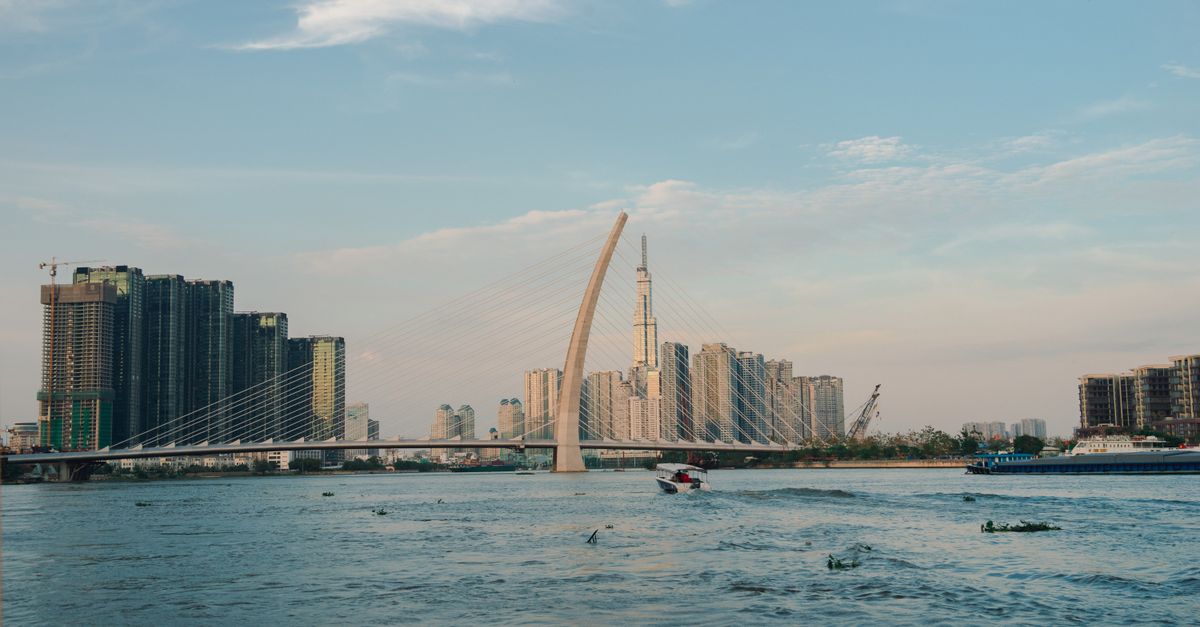
Developments along the 19.7-kilometer Metro Line 1 (Ben Thanh - Suoi Tien) and the 657-hectare Thu Thiem peninsula command foreign uptake. Units average 3,200 USD to 7,500 USD per m² in prime zones. Gross rental yields run between 3.8% and 4.8%, underpinned by international corporate relocations.
Binh Duong Industrial Corridor
Binh Duong provides higher income yields. Cities including Thuan An and Thu Dau Mot sit 25 to 30 kilometers north of central Ho Chi Minh City, housing manufacturing managers and technical directors. Purchase prices average 1,400 USD to 2,200 USD per m², with gross rental returns running between 5.5% and 6.2% per year.
Ha Noi Western Axis
Nam Tu Liem and Cau Giay drive northern residential absorption, anchored by tech clusters, ministerial relocations, and master-planned townships. Entry pricing ranges from 2,000 USD to 3,800 USD per m², supported by sustained tenant demand from Taiwanese, Japanese, and South Korean expatriates.
Frequently Asked Questions
Can a foreign buyer own landed houses in Vietnam?
Yes. Under Article 19 of Housing Law 2023, non-residents can buy landed houses or villas within approved commercial master-planned developments, up to a maximum of 250 units per administrative ward. Non-residents cannot acquire individual land plots or standalone houses outside authorized commercial projects.
What happens when the 50-year ownership term expires?
Under Article 20 of Housing Law 2023 and Decree 95/2024/ND-CP, owners apply for a 50-year extension before term expiration. The State grants extensions provided the structure meets safety standards and the owner has committed no national security violations. Alternatively, selling the property to a Vietnamese citizen immediately converts title to indefinite freehold.
Is financing available for non-resident foreign investors?
No. Domestic mortgage loans remain unavailable to non-resident foreign buyers without long-term work permits and local tax residency. Overseas buyers finance purchases via developer staged payment schedules (typically 30% to 50% paid over 24 to 36 months until handover) or home-equity lines secured in their home countries.
Sources
- National Assembly of Vietnam, Housing Law No. 27/2023/QH15: vanban.chinhphu.vn
- Government of Vietnam, Decree No. 95/2024/ND-CP Detailing Articles of the Housing Law: luatvietnam.vn
- State Bank of Vietnam, Circular on Foreign Exchange Control for Inbound Real Estate Transactions: sbv.gov.vn
Expert Reviewer: Tin Pham, Director of Sales & Digital Marketing
Want a deeper market briefing?
Our research desk publishes a 40-page quarterly Vietnam Real Estate Brief. Free for qualified investors.
Request the briefMore articles
All news Property Sale/Resale
What the Housing Law 2023 and Land Law 2024 Actually Changed for Foreign Buyers
You've seen the spreadsheets. Ho Chi Minh City asking prices ticking upward district by district, Binh Duong industrial zones pulling in new manufacturers, Da Nang drawing retiree capital from Korea and Taiwan.
Read article Property Sale/Resale
Green Skyline: Handover Is Close - What to Inspect and When Your 50-Year Term Starts Counting
Handover is stated as October 2026, which means the most important work for a foreign buyer at Green Skyline is no longer choosing a floor plan or comparing marketing claims.
Read article Property Sale/Resale
Can Taiwanese Buy Property in Vietnam? Quota, 50-Year Term and the Exact Rules (2026)
An overseas buyer can reserve an apartment in Ho Chi Minh on Monday, then discover on Tuesday that the building’s foreign-ownership quota is nearly full.
Read articleThe essentials every foreign buyer should read before reserving.